Rubber Roll Rice Husker: How It Works
A rubber roll husker removes the outer husk from paddy by passing grains between two rubber-covered rolls. The rolls normally rotate at different peripheral speeds. The resulting squeezing and shearing action separates the husk from the rice kernel while attempting to keep the brown rice intact.
On this page
How a Rubber Roll Husker Works
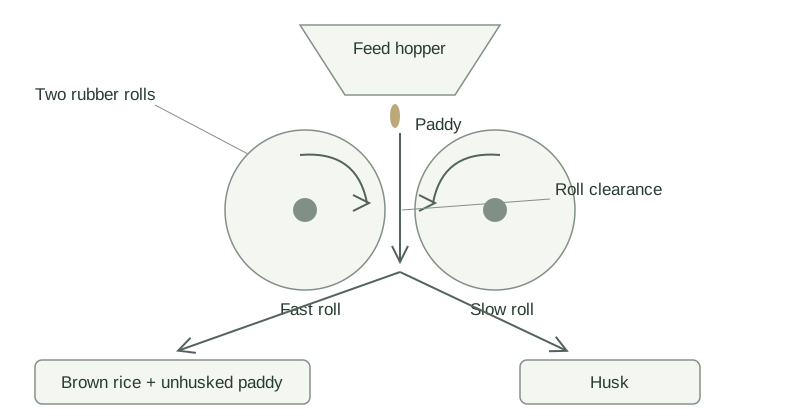
Paddy enters the narrow gap between two rubber rolls.
Because the rolls move at different speeds, the grain experiences both compression and shear.
This action removes the husk.
The product leaving the rolls is not normally finished white rice. It still requires husk aspiration and separation of unhusked paddy from brown rice.
Why Roll Clearance Matters
The distance between the rubber rolls is one of the most important operating adjustments.
If the gap is too large:
- husking rate may decrease
- more unhusked paddy remains
- more grain must be recirculated
If the gap is too small:
- excessive pressure can be applied
- rubber rolls may wear faster
- grain damage may increase
- power demand may increase
The correct setting depends on grain dimensions, paddy condition and machine design.
Rubber Roll Wear
Rubber rolls are wear parts.
As they wear:
- roll diameter changes
- the working surface changes
- the effective clearance may change
- husking performance may decrease
Operators should inspect roll condition regularly rather than waiting for severe husking failure.
Common Problems
Low husking rate
Possible causes:
- roll gap too wide
- worn rubber rolls
- uneven feeding
- unsuitable paddy condition
Excessive grain breakage
Possible causes:
- excessive pressure
- incorrect roll setting
- cracked or excessively dry paddy
- downstream milling pressure
Husk remaining with brown rice
Possible causes:
- aspiration airflow too low
- aspirator or duct problems
- poor downstream separation
Rubber Roll Husker vs Rice Whitener
A husker removes the outer hull.
A whitener removes bran from brown rice.
They perform different operations and should not be treated as interchangeable machines.
Where It Fits in the Milling Line
Pre-cleaner → Rubber Roll Husker → Husk Aspiration → Paddy Separator → Rice Whitener
Sources & Technical References
References support general principles. Machine-specific settings require the matching manufacturer manual.
- Commercial rice milling systems ↗IRRI Rice Knowledge Bank · Process-stage definitions and line arrangement.
- Technical bulletin: brown rice milling and rubber-roll shearing action ↗PHilMech · Describes the difference in peripheral roll velocity and its shearing action; no universal roll clearance is specified here.